Habit Tracking Calendar: Map Your Daily Disciplines
A habit tracking calendar is a weekly or monthly grid where you mark off daily disciplines like prayer, scripture, fasting, and movement, so a missed day is visible at a glance instead of hidden inside an app. If you keep restarting discipline runs, the grid shows you exactly where the week breaks down.
By K.A. Perkins · About me · Author profile ·
How this article was made: drafted with AI writing tools from the Tribal Challenge curriculum and published under the editorial direction of K.A. Perkins. Scripture references should be read in context.
Key takeaways
- A habit tracking calendar shows every day of the week at once, making missed days and weekly patterns visible instead of hidden inside an app.
- Build a 6x8 grid with disciplines as rows, days as columns, and a grace column to track five to eight non-negotiables like prayer, scripture, and movement.
- Log misses honestly instead of erasing the month; missing one day has no measurable effect on habit formation, but two misses in a row signals you should shrink the discipline.
- Paper wins on friction, spreadsheets win on review ability, and apps win on accountability; match the format to the specific failure you actually experience.
- Review your calendar weekly by counting completions per discipline, finding your weakest day, and adjusting only one rule at a time.
Habit Tracking Calendar: Map Your Daily Disciplines on One Grid
This guide gives you a fill-in template and an honest comparison of paper, spreadsheet, and app formats.
What is a habit tracking calendar and how does it differ from a habit tracker app?
A habit tracking calendar is a grid, paper or digital, that shows every day of the week at once, with each discipline marked as done or missed. A habit tracker app logs the same data but automates reminders and streak counting for you.
The difference is what each format forces you to see. A calendar makes patterns visible: you spot that you always miss movement on Thursdays or that your scripture reading collapses after three days. An app tells you that your streak broke, but rarely shows you why.
That distinction matters if you keep restarting. 75 Hard's structure is binary and unforgiving, which is why many men abandon it mid-run. Tribal Challenge takes a different angle: 13 daily disciplines including prayer, scripture, fasting, and movement, built around identity rather than streaks, with grace days and a 15-tribe community for accountability.
Its own guide on how to build habits that last beyond 100 days makes the same case: patterns beat streaks.
The honest trade-off: a calendar demands you show up and mark it yourself, which some will skip. An app does the remembering for you, but you can ignore a notification as easily as an empty grid.
Which habits belong on a Christian discipline calendar?
Pick 5 to 8 non-negotiables. More than that and your grid becomes a guilt list you abandon by week two; fewer than five and you are tracking a mood, not building a rule of life.
Spiritual anchors: prayer, scripture, fasting
Prayer and scripture belong on the calendar daily, even if the entry is 10 minutes. Fasting works better as a weekly or set-days habit than a daily one, so mark it on fixed days rather than every cell.
Body and mind: movement, sleep, work
Movement mirrors what you already know from 75 Hard culture: a defined daily action, not "be healthier." Sleep and a defined work cutoff keep the grid honest about recovery, which is where most restarts actually begin.
Relational: service, family, community
Add one relational discipline, such as a daily check-in with your wife, a friend, or your tribe. Discipline that never touches other people tends to collapse privately.
Cap the grid at eight rows and audit it weekly. The 100-day challenge tracker guide at 100 Day Challenge Tracker: Spiritual & Physical Growth shows how to measure progress without restarting from zero.
How do you structure a weekly habit tracking calendar layout?
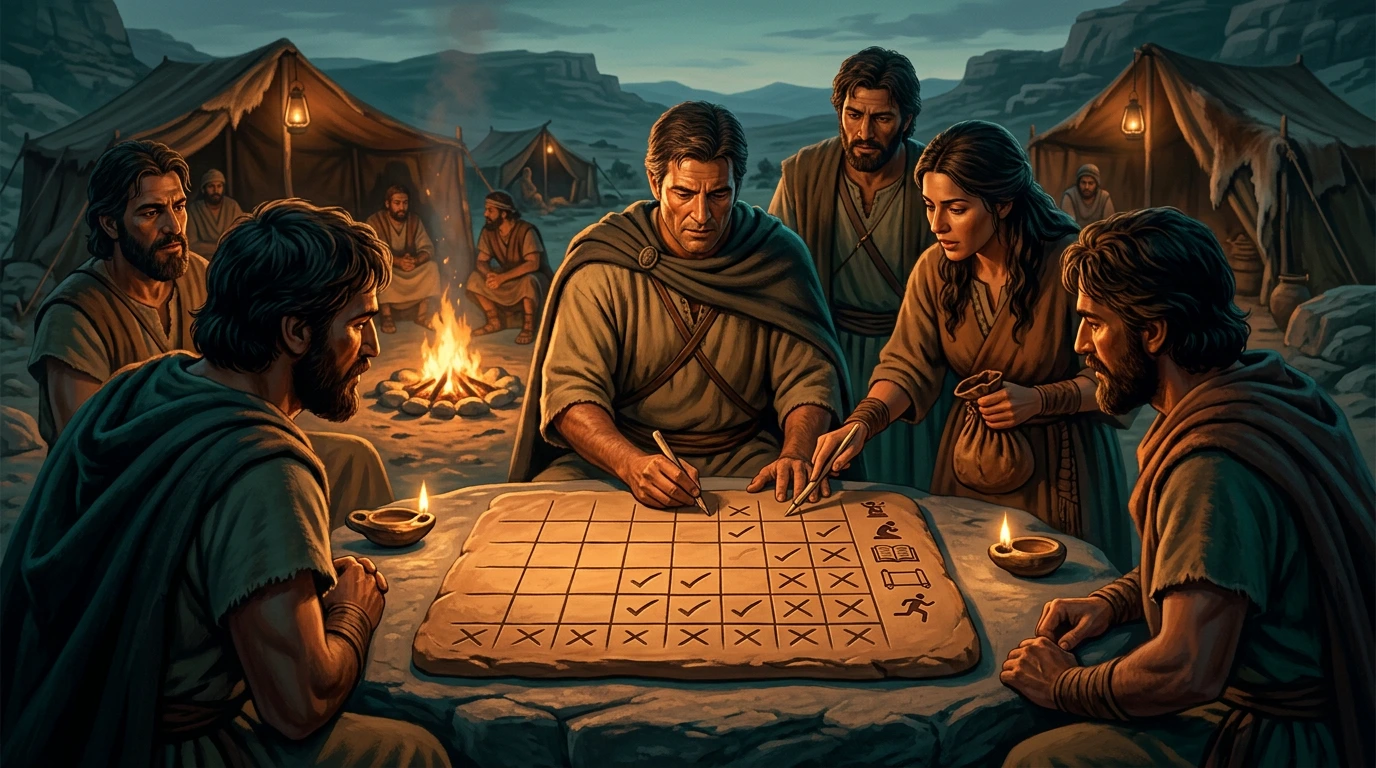
Build your week as a fill-in template: one row per discipline, one column per day, plus two extra columns for grace days and a weekly review. That gives you a 6x8 grid you can print, copy into a spreadsheet, or rebuild in any app.
Rows stay fixed all month so you can see patterns; only the dates change.
The 6x8 grid: disciplines down, days across
List your daily disciplines as rows. Most men running a rule of life land on five to seven non-negotiables: prayer, scripture, movement, fasting or a food rule, and one or two personal disciplines like journaling or a cold shower. Columns run Monday through Sunday, then a "Grace" column and a "Review" row at the bottom.
The grid stays small enough to read at a glance on a phone.
Marking rules: done, missed, grace day
Use three marks only: a check for done, an X for missed, and a G for grace day. A grace day covers travel, sickness, or family emergencies without breaking the run. 75 Hard's official rules allow no such flexibility, which is one reason many men restart it repeatedly.
Decide up front how many grace days you get per week; one is a common starting point. More than that and the calendar stops measuring anything.
A worked example week
Discipline Mon Tue Wed Thu Fri Sat Sun Grace Prayer ✓ ✓ ✓ ✓ ✓ ✓ ✓ 0 Scripture ✓ ✓ ✓ G ✓ ✓ ✓ 1 Movement ✓ X ✓ ✓ ✓ ✓ ✓ 0 Fasting rule ✓ ✓ ✓ ✓ ✓ ✓ ✓ 0 Journal ✓ ✓ ✓ ✓ G ✓ ✓ 1
The review row is where you write one sentence: what broke, and what changes next week. Prayer deserves its own deeper treatment; see building a warrior mindset through daily prayer.
Paper, spreadsheet, or habit tracking calendar app: which format fits your routine?
The honest answer: the best format is the one you'll still open on day 40. Paper wins on friction and cost. A printed grid on the fridge takes three seconds to tick and never needs charging, but it can't remind you, and it can't hold you accountable when you're travelling.
When paper wins
If you're home most days and your disciplines fit on one page, paper is hard to beat. The physical act of marking an X builds identity faster than tapping a screen. The failure mode is silence: nobody knows you stopped.
When a spreadsheet wins
A spreadsheet wins on review ability. Colour-code each day, add a weekly summary row, and you can see at a glance whether fasting days cluster before they collapse. It costs nothing and backs up automatically.
The failure mode is friction: opening a file on your phone to log a prayer is enough of a speed bump that many men skip the log, then skip the prayer.
When an app wins
An app wins on accountability and reminders, which is exactly where restart-prone men fail. If you've run 75 Hard and kept breaking on day 20, your problem isn't logging, it's the absence of people and prompts.
That's the gap Tribal Challenge is built for: 13 daily disciplines including prayer, scripture, fasting, and movement, logged mobile-first, inside a 15-tribe community that sees your run. Grace days are built in, so a missed day is handled with grace rather than a reset to zero.
Run through the same criteria honestly: Tribal Challenge costs more than paper, adds screen friction paper doesn't have, and its community depth depends on your tribe actually showing up. Where it beats both formats is the restart problem. A spreadsheet can't text you when you go quiet; a tribe can.
If your disciplines include fasting, the app's structure around it (fasting discipline) gives you a rhythm to follow instead of a blank cell to interpret. Pick paper for simplicity, a spreadsheet for analysis, an app for accountability. Match the format to the failure you've actually had.
How do you review and adjust your calendar at the end of each week?
Set a 10-minute appointment on Sunday evening. Open your habit tracking calendar and count completions per discipline, not per day: prayer 6/7, movement 4/7, scripture 5/7. The raw numbers tell you more than how the week felt.
Next, find your weakest day. Most restarts trace to one recurring gap, usually the day with the least structure. If Wednesday keeps failing, the problem is Wednesday, not your discipline.
Then adjust one discipline only. Lower the bar on the one you missed most: three verses instead of a chapter, a 15-minute walk instead of a full workout. Changing five rules at once is how you end up tired of starting over by Thursday.
Apps like YouVersion and Tribal Challenge build weekly check-ins into their flow for this reason; Tribal Challenge's about page frames the review as identity work, not streak repair. Write one sentence: what changed, and why. Then close the calendar until Monday.
How do you stay consistent when you miss a day on your calendar?
The never-miss rule is why you keep restarting. 75 Hard requires you to start at day one after any slip, so a single miss on day 40 erases six weeks of work. But the habit itself does not vanish that fast. , 2010, European Journal of Social Psychology).
So log the miss, don't erase the month. Write "missed" in the box, note what knocked you off, and run the next day as planned. A grace day works the same way if your rule of life allows one per week: the box gets marked, the streak continues, the honesty stays intact.
What breaks runs is the restart rule, not the miss. Two misses in a row is the signal to shrink the discipline, not abandon the calendar: drop movement to a 15-minute walk, drop fasting to a half-day, keep prayer and scripture untouched. Identity holds when the calendar records reality instead of punishing it.
How do pastors and small-group leaders run a shared calendar for a congregation?
Start with one shared weekly grid: the same daily disciplines (prayer, scripture, movement, one group-specific non-negotiable) on every row, one column per day. Each man marks his own line.
The leader's job is not policing marks; it is running a fixed review rhythm, typically a 10-minute check-in after Sunday service or a midweek message where each member posts one win and one miss. That rhythm is the accountability layer. Without it, a shared calendar is just a quieter solo tracker.
When choosing a habit tracking calendar app for a group, check four things: private-per-member visibility (men will mark honestly if marks aren't public), a grace-day rule the leader can set, bulk seat purchasing, and export so small groups can take their data with them.
Hallow and YouVersion support shared reading plans but not a full discipline grid; 75 Hard is single-player. Tribal Challenge is built for this use case, with a 15-tribe community structure and grace days, though it is mobile-first, so leaders who want a printed wall grid should pair it with paper.
FAQ
What is a habit tracking calendar?
It is a grid showing every day of the week at once, with each discipline marked done or missed. An app logs the same data but automates reminders. The calendar's advantage is visibility: you see that movement fails on Thursdays, where an app only tells you the streak broke.
How do I make a weekly habit tracker calendar?
Build a 6x8 grid: disciplines as rows, days Monday through Sunday as columns, plus a Grace column and a Review row. Use three marks only: a check for done, an X for missed, and a G for a grace day. Keep the same rows all month so patterns show, and cap it at eight disciplines.
What habits should I put on a Christian habit calendar?
Pick five to eight non-negotiables: prayer and scripture daily, fasting on fixed days, movement as a defined action, and one relational discipline like a daily check-in with your wife. Fewer than five tracks a mood; more than eight becomes a guilt list you abandon by week two.
Is a habit tracking calendar app better than paper?
Neither is universally better. Paper wins on friction: three seconds to tick, never needs charging. An app wins on accountability and reminders, which is where restart-prone men fail. A spreadsheet sits between them, best for color-coded weekly review. Match the format to your specific failure.
What do I do when I miss a day on my habit calendar?
Log the miss, do not erase the month. Write missed in the box, note what knocked you off, and run the next day as planned. Missing a single day has no measurable effect on habit formation. Two misses in a row is the signal to shrink the discipline, not abandon the calendar.