How to Set Up a Prayer War Room and Stick With It
A prayer war room is a dedicated space, even a closet corner, where you pray with a written battle plan: specific scriptures, specific requests, and a log of how God answers. This guide covers the movie origin, a step-by-step small-space setup, a copyable journal template, and how to keep the habit locked in past week one.
By K.A. Perkins · About me · Author profile ·
How this article was made: drafted with AI writing tools from the Tribal Challenge curriculum and published under the editorial direction of K.A. Perkins. Scripture references should be read in context.
Key takeaways
- A prayer war room requires only four physical items: a chair, a light, a wall, and a journal.
- Tape three to five specific scriptures to your wall to pray aloud, matching verses to your actual fight rather than a generic list.
- Structure your journal with six daily sections including a battle plan and a grace note to survive missed days without restarting.
- Write a five-part battle plan for one specific fight at a time, pairing a prayer request with a single obedient action.
- Maintain the habit past week one by planning grace days in advance and asking one or two men to hold you accountable weekly.
What is a prayer war room and where does the idea come from?
A prayer war room is a dedicated space, often a closet or corner, where you pray deliberately: scripture on the walls, a written battle plan, names you're fighting for.
The idea entered mainstream church culture through the 2015 film War Room, directed by Alex Kendrick, where Miss Clara, played by Karen Abercrombie, prays from a closet she cleared out for the fight.
The biblical roots behind the war room concept
The concept draws on Matthew 6:6, where Jesus tells believers to pray to the Father in secret, and on Ephesians 6, which frames prayer as part of spiritual warfare. It is structured, private prayer with a plan, not a new doctrine.
From movie set to spare closet: why the idea stuck
Men tired of restarting 75 Hard recognise the pattern: a defined space, daily non-negotiables, accountability. Tribal Challenge applies the same structure to faith, built by a founder who kept half-finishing discipline himself (K. A. Perkins' story).
How does Miss Clara's prayer strategy in the War Room movie actually work?
Miss Clara's method is simple: a fixed space, a written plan, and daily repetition. She doesn't wait to feel like praying. She goes to her closet, walks the floor, and works through specific requests tied to specific scriptures. The structure is the point.
The three moves: walk around, read aloud, pray scripture
First, she physically enters the space, which separates prayer time from the rest of the day. Second, she reads her battle plan out loud, naming the situation and the verses against it. Third, she prays scripture itself, turning written words into spoken petition. Walk in, read aloud, pray the Word.
What Miss Clara's war room prayer teaches about strategy over emotion
Her approach treats prayer like a non-negotiable with a plan behind it, not a mood you wait for. That's the same logic behind a rule of life: fixed daily disciplines you keep whether or not you feel locked in.
If you want that structure applied to your whole day, the Discipline Blueprint maps 13 daily practices the same way Miss Clara maps her battle plan.
How do you set up a prayer closet or war room in a small space?
You need four things: a chair, a light, a wall, and a journal. Everything else is optional.
Five war room prayer closet ideas for apartments and shared homes
- A corner of your bedroom with a chair facing a blank wall.
- The inside of a wardrobe door with taped-up index cards.
- A bathroom or car at 5:30am before the house wakes.
- A folding chair in the garage.
- Your kitchen table after everyone leaves, with a screen divider.
What you actually need: chair, light, wall, journal
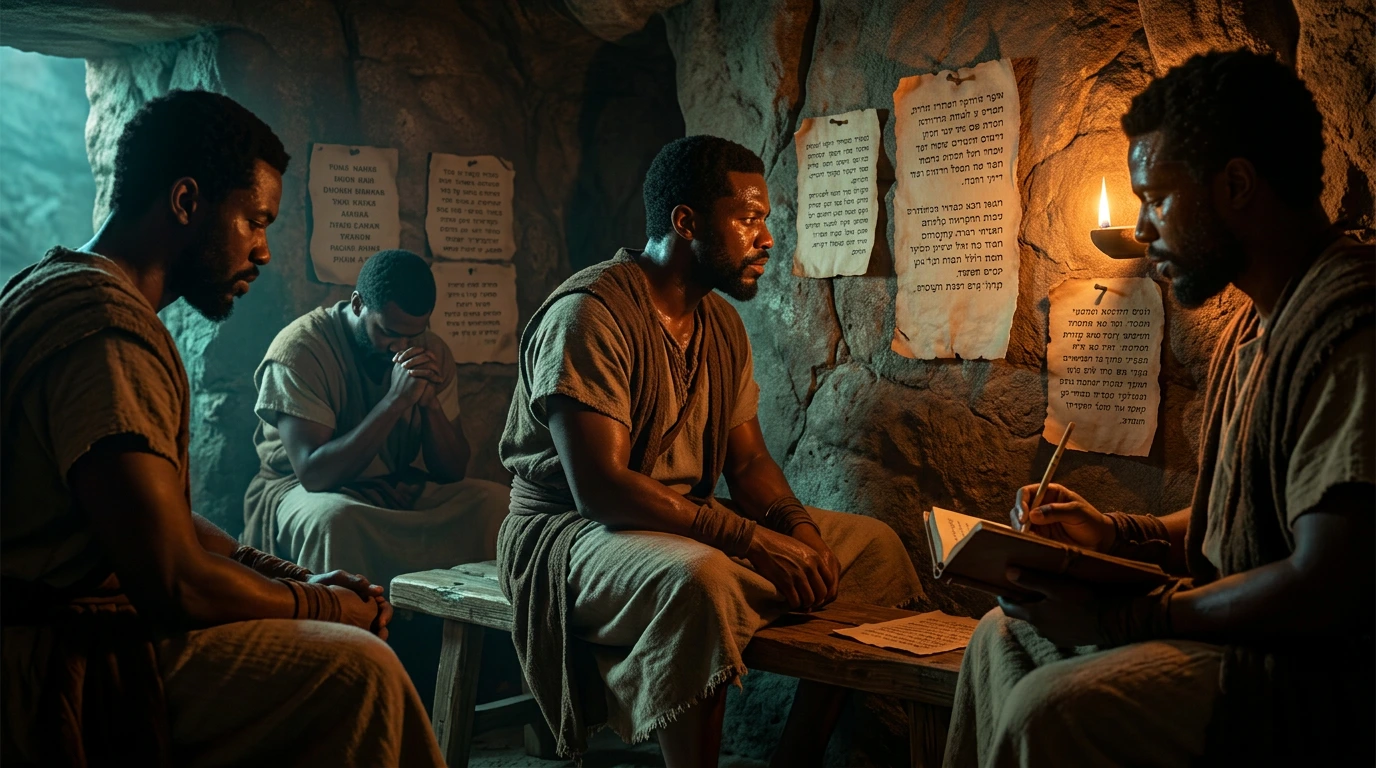
The wall is the war room. Tape up three columns: scriptures you are praying back to God, names of men you are fighting for, and your battle plan. Pray the verses aloud, not from memory.
Paul commands praying without ceasing (1 Thessalonians 5:17), and a fixed wall with fixed verses is how an ordinary man obeys that in a one-bedroom flat. If mornings are your slot, anchor the chair to a fixed routine like this Christian morning routine so the location and the hour reinforce each other.
What should go on your war room wall: scriptures, names, and battle plans?
Choosing war scriptures for your specific fight
Write verses that match the fight you're actually in, not a generic list. If the battle is sexual temptation, put 1 Corinthians 10:13 and Job 31:1 up. If it's provision, Philippians 4:19. If it's fear, Isaiah 41:10.
Three to five verses is enough; you want ones you can pray from memory by week two. Copy them out by hand. The act of writing is part of the locking-in.
The name list: who you are praying for and why
Miss Clara's strategy was never private self-improvement; it was intercession. Your wall needs a name list: your wife, your kids, your pastor, the coworker you resent, the friend drifting from church. One line each, with the specific ask.
Update it as prayers are answered, because visible answers are what keep you locked in past week one.
The third item is the battle plan itself, covered in the next section. If you want a daily structure that holds these pieces together, the 100 Day Challenge for Christians pairs prayer with twelve other daily disciplines and a community that notices when you stop showing up.
How do you structure a war room prayer journal template?
A war room journal works when it has fixed sections you fill in daily, so you never open a blank page wondering what to write. Six sections are enough.
The six-section template: date, scripture, request, battle plan, grace note, answered log
Section What you write Why it earns its space Date The day, and week number if you're tracking Shows restart patterns honestly Scripture One verse, copied by hand Anchors the prayer in the Word, not mood Request One specific ask, one sentence Vague prayers can't be answered visibly Battle plan The action you'll take today on that request Prayer plus obedience, like Miss Clara's strategy Grace note Where you fell short, without self-punishment Keeps the habit alive after a bad day Answered log Date the request was resolved, and how Builds the faith record that stops you starting over
The grace note is the section most men skip and most need. If your only metric is a perfect streak, one missed morning ends the whole journal.
The Tribal Challenge app builds around this same insight: 13 daily disciplines including prayer and scripture, with grace days built in and a 15-tribe community for accountability (the Tribal Challenge app). Their daily reflection journal for Christians follows the same fill-in structure if you'd rather keep it on your phone.
A prayer book war room page, worked example
Here's a filled page, illustrative:
Date: Tue, week 3 Scripture: Philippians 4:6-7 Request: Wisdom on the job decision by Friday's deadline. Battle plan: List pros/cons tonight; ask Marcus to pray over it at breakfast. Grace note: Skipped morning prayer Monday. Prayed at lunch instead. Answered log: (open)
One page, five minutes, done before you leave the closet.
How do you build a Miss Clara-style battle plan for your situation?
Miss Clara's strategy works because she prays about one fight at a time, with scripture as her weapon. A vague request like "help my marriage" gives you nothing to pray tomorrow. A battle plan gives you a target, a verse, and a next move.
The five-part battle plan framework
Write these five lines on one card or one note in your war room:
- The fight. Name the single problem: "I'm withdrawing from my wife."
- The scripture. Pick one or two verses that speak directly to it.
- The prayer. One sentence you can pray out loud, daily.
- The ask. What you're asking God to change, in you first.
- The move. One obedient action you take regardless of outcome.
One fight, one card. When that battle resolves, write the next card.
Example battle plan: a struggling marriage
- The fight: "We talk like roommates."
- The scripture: Ephesians 5:25; Philippians 2:4.
- The prayer: "Lord, make me love her like Christ loved the church, starting today."
- The ask: A softened heart, hers and mine.
- The move: Put the phone down at 8pm and ask her one real question.
Pray it daily, review it weekly, and update the move line as God answers.
How do you pray biblically about a struggling marriage, such as a cheating spouse?
Biblical prayer here means praying truth: name the betrayal to God without softening it, then pray for your own heart before you pray about his. Write the specific verses you're standing on into your battle plan, and pray them out loud in your war room daily.
Praying truth, boundaries, and restoration
Scripture holds two things together: real grief and real hope. Pray Psalm 55 honestly, forgive as a decision rather than a feeling, and set boundaries as an act of protection, not punishment. Restoration, if it comes, follows repentance, not your prayer volume.
When to bring in pastoral help alongside prayer
A war room is not a substitute for counsel. Bring a pastor or trusted elder in early. Unlike 75 Hard's fixed 75-day structure, reconciliation has no deadline, so build grace days into your plan and keep praying regardless of his response.
How do you keep a war room prayer habit going after the first week?
Daily disciplines, grace days, and accountability
Week one runs on motivation, but week two runs on structure, and that is where most war rooms go dark: the chair becomes laundry storage, the index cards curl, and the journal opens to three blank pages in a row.
Treat your prayer time as one of your daily non-negotiables: same chair, same time, journal already open to yesterday's page so you start mid-conversation rather than from scratch.
Plan grace days in advance, one or two a week, so a missed morning is a planned concession rather than a reason to tear the whole wall down and restart from zero.
That is the difference between a rule of life and another streak you abandon, so name one or two men who will ask you a straight question every week: did you get in the room, and what did you log? Accountability you can see beats accountability you intend to find.
Where a structured challenge fits: Tribal Challenge's 13 daily disciplines
If you keep restarting, a container helps. Tribal Challenge is a faith-based discipline challenge built on 13 daily disciplines, prayer and scripture among them, with a 15-tribe community for accountability and grace days built in. It is a 75 Hard alternative that treats discipline as identity, not a streak to protect.
Where it falls short: it is not a war-room tool, so it will not hold your battle plan or your journal, and the fixed daily list may not match your own rule of life. Run it alongside your closet, not instead of it.
FAQ
What is a prayer war room?
A prayer war room is a dedicated space, often a closet or corner, where you pray with a written plan. You tape scriptures to the wall, list specific requests, and log answered prayers. The idea entered mainstream church culture through the 2015 film War Room, where Miss Clara prays from a cleared-out closet.
Do I need a whole closet, or can a war room be a corner of a room?
A corner works fine. The essentials are a chair, a light, a wall, and a journal. A bedroom corner with a chair facing a blank wall, the inside of a wardrobe door with taped-up index cards, or a kitchen table after everyone leaves all function perfectly as war rooms.
What scriptures should I put in my war room?
Choose verses that match the fight you are actually in. For sexual temptation, use 1 Corinthians 10:13 and Job 31:1. For provision, Philippians 4:19. For fear, Isaiah 41:10. Three to five verses is enough, copied out by hand, so you can pray them from memory by week two.
How do I pray for a cheating husband?
Name the betrayal to God without softening it, then pray for your own heart before you pray about his. Pray Psalm 55 honestly, treat forgiveness as a decision rather than a feeling, and set boundaries as protection. Bring a pastor or trusted elder in early, since a war room is no substitute for counsel.
How long should a daily war room prayer session take?
Five to fifteen minutes is enough if your journal is already open to yesterday's page. Work through your battle plan: read the verses aloud, pray the one-sentence prayer, note the day's move, and log anything answered. Consistency at the same chair and hour matters more than length.